In grinding circuits across industries such as cement, minerals, mining, and materials processing, the air separator plays a critical role in determining product quality and mill efficiency.
The job of the separator is simple in principle:
separate fine particles (finished product) from coarse particles returning to the mill.
But the physics behind it creates a complex operational challenge.
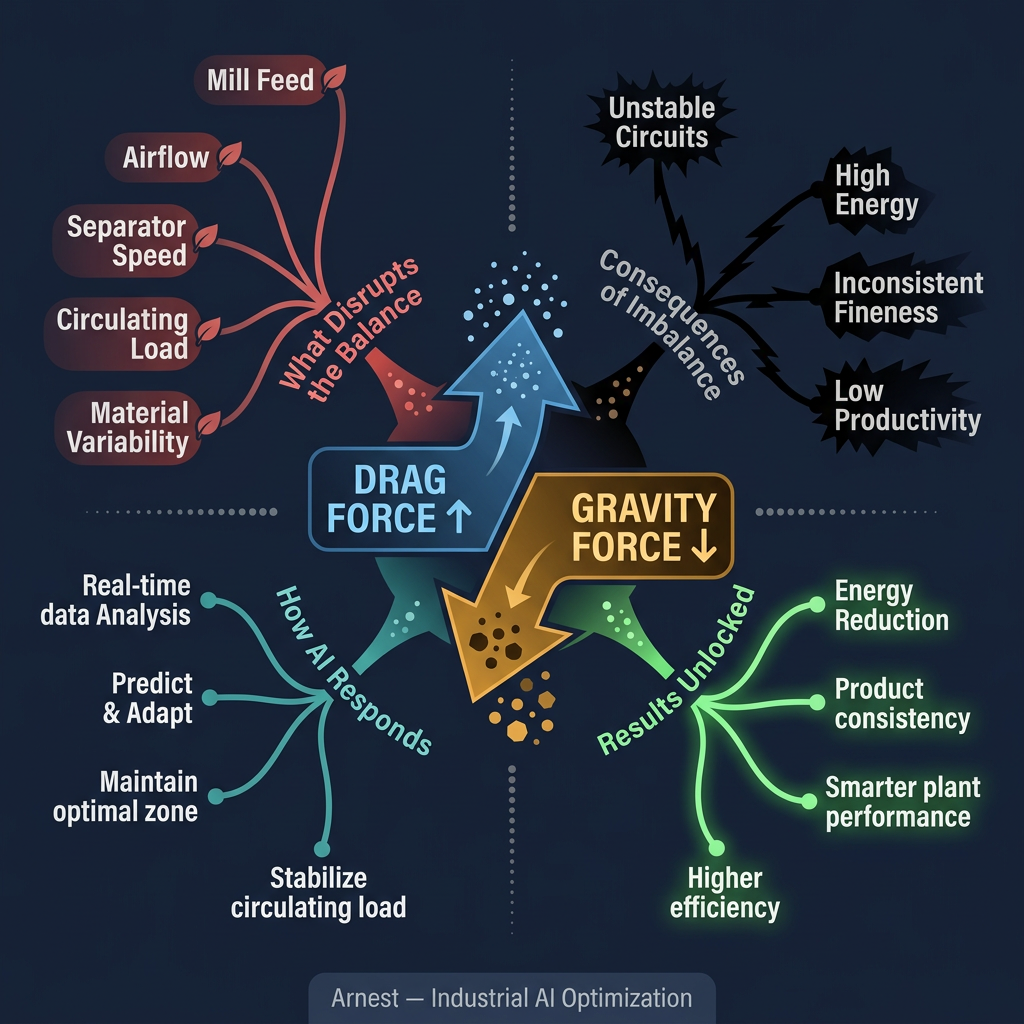
The separation process depends on the balance between two opposing forces:
• Drag force from the air stream, which carries fine particles upward
• Gravity force, which pulls larger particles downward
Because gravity increases faster with particle size than drag force, only particles below a certain size are carried with the air stream while larger particles fall back to the mill.
In real plant conditions, however, this balance constantly changes due to variations in:
• Mill feed characteristics
• Air flow and separator speed
• Circulating load
• Process disturbances and material variability
Even small changes can lead to:
- Unstable grinding circuits
- Higher energy consumption
- Inconsistent product fineness
- Reduced mill productivity
This is where AI-driven process optimization can make a significant difference.
By continuously analyzing real-time plant data, AI-based optimizers can:
- Maintain the optimal separator operating zone
- Stabilize the grinding circuit and circulating load
- Improve product fineness consistency
- Reduce specific energy consumption of mills
Instead of reacting to deviations after they occur, AI enables plants to predict, adapt, and maintain optimal performance continuously.
At Arnest, we focus on applying Industrial AI optimization to complex process operations, helping industries unlock higher efficiency, better product quality, and smarter plant performance.