In the paper & pulp industry, the bleaching process is essential for removing lignin and impurities to achieve the required pulp brightness and product quality. However, bleaching is a complex multi-stage chemical process, and maintaining consistent results can be challenging.
Many plants encounter operational issues such as:
- Difficulty adapting to raw material variations
• Process variability across multiple bleaching stages
• Over-consumption of bleaching chemicals
• Inconsistent brightness levels and product quality
Traditional control approaches often regulate individual parameters, but they struggle to manage the dynamic interactions between pulp characteristics, chemical dosing, and process conditions across the entire bleach plant.
This is where Industrial AI–driven process optimization can deliver significant value.
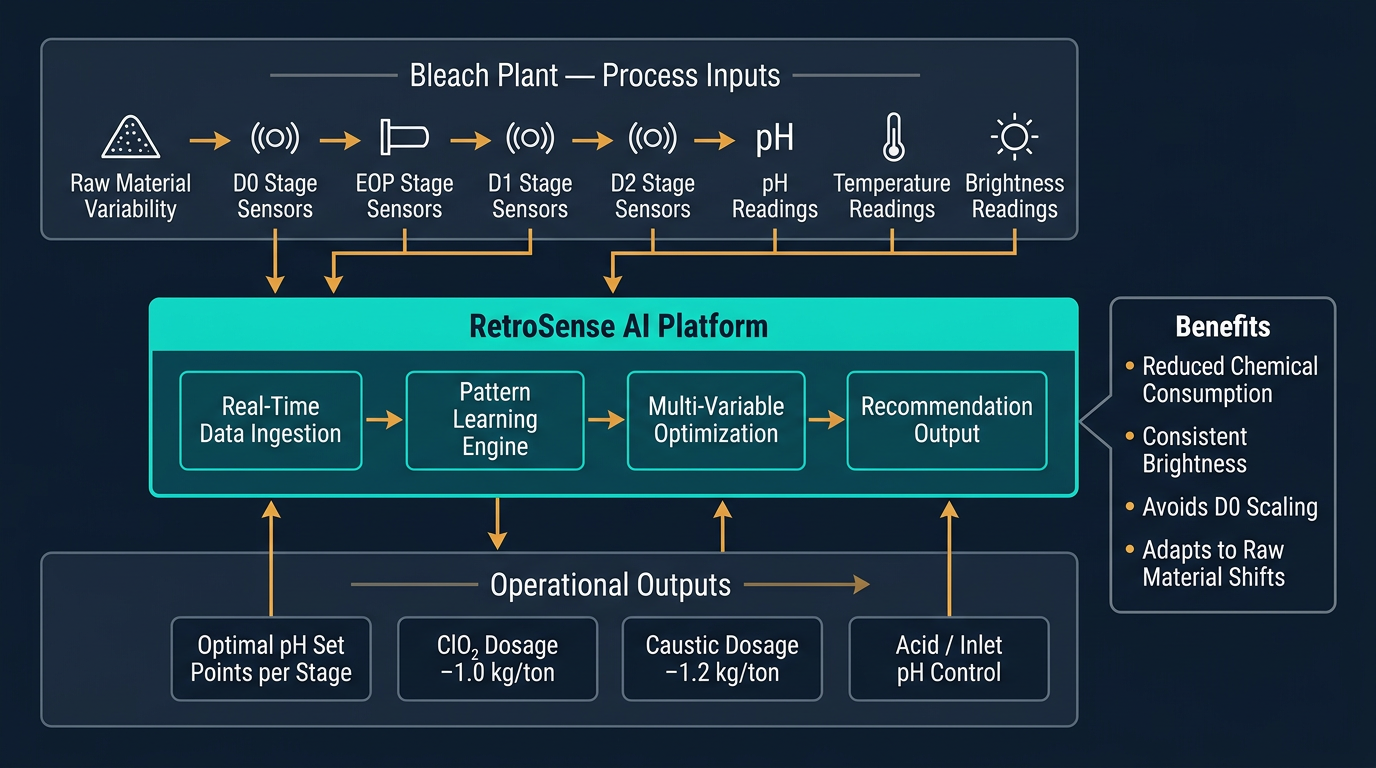
By analyzing real-time process data and learning the relationships between process variables, AI-based systems can support operators by:
- Providing optimal pH set points for each bleaching stage
- Recommending optimal acid, chlorine dioxide (ClO₂), and caustic dosages
- Adapting dynamically to raw material variations
- Minimizing variability in final pulp brightness
Operational Benefits
- ClO₂ (Chlorine Dioxide) – Minimum 1.0 kg/ton reduction in consumption
- Caustic – Minimum 1.2 kg/ton reduction in consumption
- Acid – Significant reduction potential through optimized inlet pH control
- Process Optimization – Improved pH control helps avoid scaling issues in D0 washing
With AI-enabled insights, paper mills can move toward more stable bleaching operations, optimized chemical usage, and consistent product quality, while improving both efficiency and sustainability.
At Arnest, we focus on applying Industrial AI to complex process industries, helping manufacturers unlock smarter, data-driven operations.