Modern industrial processes—whether in cement, steel, paper, mining, or other process industries—are becoming increasingly complex. Operations must continuously handle variations in raw materials, fuels, process conditions, and production demands. While traditional control strategies have supported plants for decades, they often struggle to manage these dynamic and nonlinear environments.
Understanding the limitations of conventional systems highlights the need for AI-driven adaptive control.
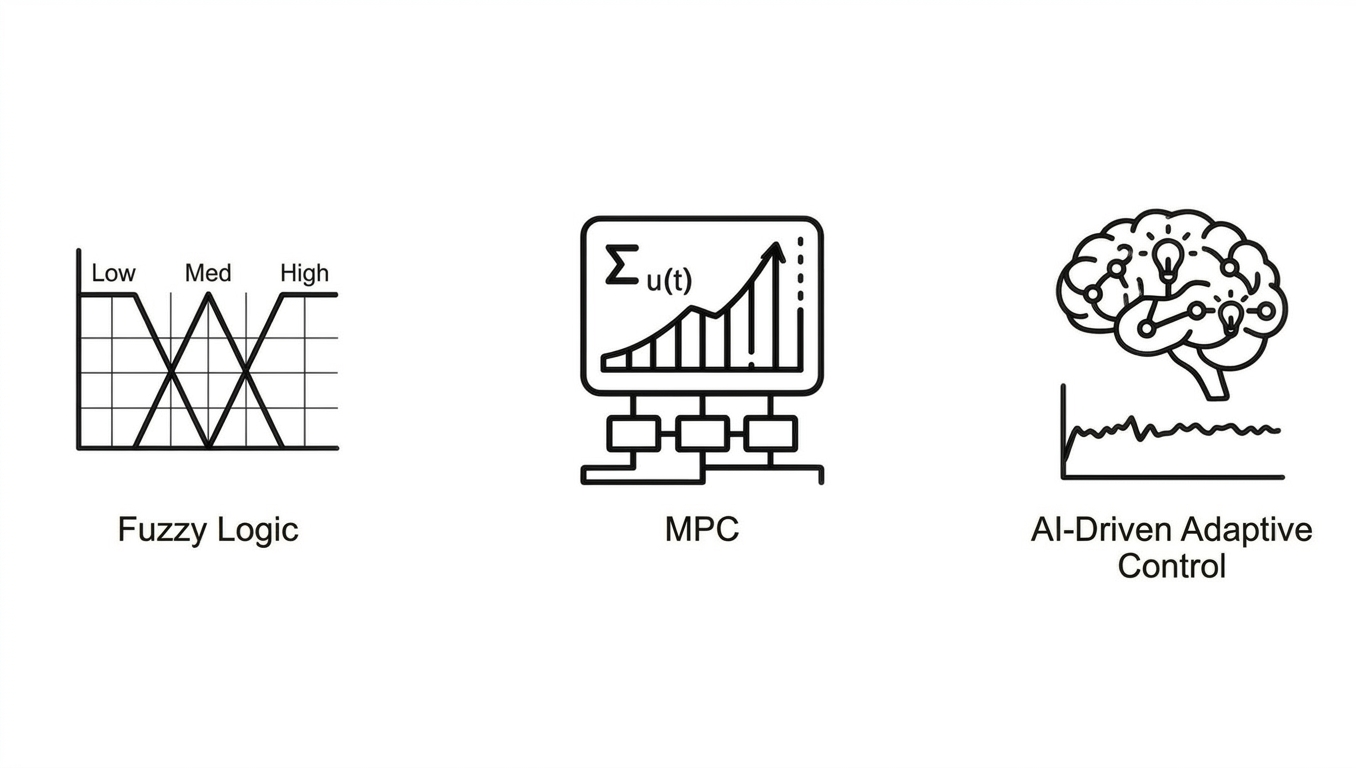
How Different Control Approaches Compare
Fuzzy Logic Systems
• Rule-based control using manually defined IF–THEN logic
• Performance depends heavily on the quality of predefined rules
• Reactive behavior can lead to oscillations during disturbances
• Requires manual rule redesign when process conditions change
Model Predictive Control (MPC)
• Uses mathematical process models for multivariable optimization
• Maintains stability if the process model accurately represents the plant
• Sensitive to model mismatch and process drift
• Requires model rebuild and retuning when operating conditions change
AI-Driven Adaptive Control
A modern approach that learns directly from real plant data and operator expertise.
• Continuously learns nonlinear process behavior
• Predicts emerging instability and stabilizes operations early
• Automatically adapts to changes in raw materials, fuels, and operating conditions
• Uses digital twin simulations to preview the impact before applying control actions
• Improves continuously as more operational data becomes available
In simple terms:
Fuzzy systems react.
MPC systems predict within a fixed model.
AI-driven systems adapt to real plant intelligence in real time.
As industries move toward smarter, more resilient operations, adaptive AI-based control strategies are helping organizations operate with greater stability, efficiency, and long-term sustainability across diverse process environments.
At Arnest, we focus on enabling industries to transition from static control logic to intelligent, self-learning operations powered by Industrial AI.